Typejust
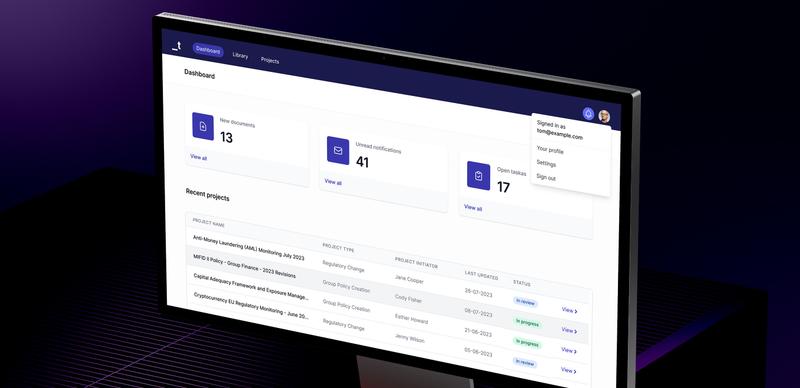
An end-to-end compliance platform for regulated organizations
Typejust turns regulatory change from a recurring scramble into a structured workflow: every regulation is ingested, normalized, and mapped straight through to the policies, controls, and evidence that satisfy it, with support spanning Europe, the US, APAC, and emerging crypto frameworks.
Compliance in financial services is a moving target. Fintechs, crypto companies, and banks deal with scattered regulatory data, inconsistent governance, and a constant flow of new rules. It slows teams down, drains resources, and increases risk.
Typejust solves this at the root. Built with industry experts, it is an end to end compliance platform that simplifies and automates regulatory change management. It brings everything into one system, keeps regulatory data synced in real time, and turns policy updates into structured, repeatable workflows.
The impact is significant. Companies cut up to 80 percent of their manual compliance work and gain the clarity needed to move faster with less risk. Teams stay aligned, collaboration improves, and compliance becomes a smooth, predictable part of operations rather than a weekly scramble.
This is how Typejust is redefining compliance for fintech, crypto, and financial services companies that want to stay ahead of the curve.
Strategic objectives
Become the core compliance system for organizations
Turn Typejust into the default platform that centralizes regulatory data, policies, controls, and workflows for regulated businesses.
Automate 80 percent of regulatory change management
Push deeper into automation so teams spend their time deciding, not searching, interpreting, or updating documents.
Expand real time regulatory coverage across jurisdictions
Grow the regulatory intelligence engine to cover Europe, the US, APAC, and emerging crypto frameworks so global companies rely on one source of truth.
Integrate with the full compliance and risk stack
Offer native integrations with GRC tools, ticketing systems, document libraries, and internal data sources to make Typejust the center of a company’s compliance ecosystem.
Build policy, control, and audit modules that scale
Move upmarket with robust workflows, granular permissions, full audit trails, and enterprise governance so Typejust can support banks, PSPs, and global financial services groups.

Most prominent features
Horizon Scanning
Real time monitoring of new regulations so teams always know what is coming.
Policy document builder
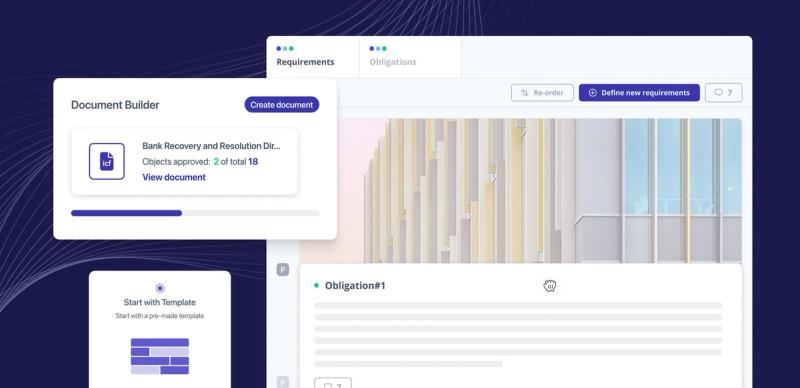
Create policies, procedures, and standards directly from regulatory requirements in one place.
Dynamic workflows
Structure tasks, assign ownership, and keep every compliance process moving without chaos.
Centralized workspace
All documents, controls, and evidence live in one system instead of scattered tools.
Control library and mapping
Use ready made controls and map frameworks instantly to reduce manual work.
Integrations
Connect existing tools so compliance data flows smoothly across the whole tech stack.
Multi jurisdiction support
Operate across regions with consistent frameworks that remove confusion and duplicate effort.
Audit ready traceability
Show clear links from regulation to policy to control to evidence during audits.
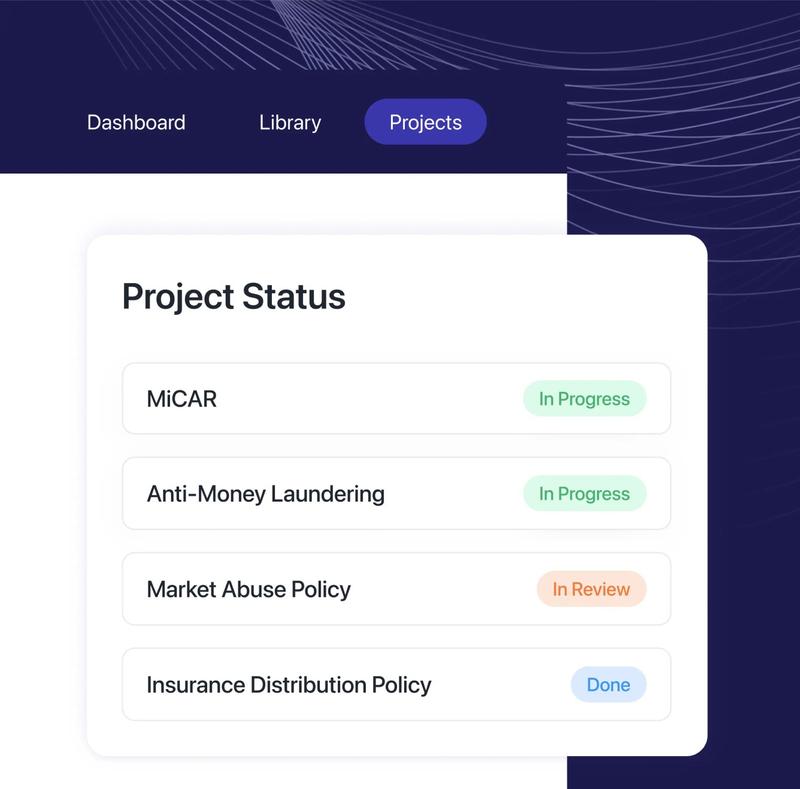
Clear results that show how the product transforms compliance for regulated companies
Up to 80% increase in efficiency across compliance initiatives
8/10 user satisfaction on usability and design
Proven across 4 regulated industries: Financial services, oil and gas, AI, and gambling
Product Development Process
The development of Typejust began with a simple principle: understand the real pain before writing a single line of code. Compliance professionals across fintech, crypto, banking, and other regulated sectors told us a similar story. They were not struggling because the rules were complex. They were struggling because the information lived everywhere, the process lived nowhere, and every update triggered a chain reaction that no one could fully track.
We started by mapping these realities with the people who lived them. Workshops, interviews, and process breakdowns revealed a pattern of fragmented knowledge, repeated manual work, and constant uncertainty about what had changed and who was responsible. These insights shaped the earliest version of Typejust.
The first build was intentionally small. Instead of launching a large platform, we created a simple version that mirrored the essential workflow of regulatory change: capture incoming updates, connect them to internal obligations, and create clarity on what needs to happen next. This stripped down prototype acted like a working sketch. Real users tested it within days, not months.
Their feedback shaped the evolution of the product. We learned what actually helped them move faster and what created friction. Many early ideas were removed. Some were redesigned. A few turned into core features that still define Typejust today. The goal was always the same. Reduce cognitive load. Make compliance managers feel in control rather than overwhelmed.
We kept development cycles tight. After each release, we observed how teams used the product and what slowed them down. We optimized the flow so users never had to wonder where they were or what the next step should be. The focus was not on adding features, but on strengthening the core experience. Simplicity and clarity became guiding principles throughout the entire build.
Engaging closely with early adopters helped us refine the product at speed. Their use cases were extremely diverse, which pressured us to design a system that adapts to different organizational structures without becoming bloated. Every time a user replaced a manual process with Typejust, we studied the behavior and improved the experience for the next one.
Once the foundations were stable, we expanded the product around the same logic. New capabilities were introduced only when they supported the central mission: turn regulatory change into a predictable, structured, and clear workflow. Nothing more. Nothing less.
Today, Typejust reflects the result of that process driven approach. It is not a collection of features. It is a tool shaped directly by the daily realities of compliance teams. A system built through constant iteration with the people who use it. And a product that continues to evolve based on the same principle that shaped the very first version. Understand the problem deeply, then build the simplest possible solution that removes the friction.
Technical Approach
Typejust is built on a modular, scalable architecture that can handle the pace of regulatory change without slowing down. The core idea was to separate responsibilities into clear layers so each part of the system can evolve independently as regulations grow, industries shift, and new jurisdictions come online.
The backend was designed around structured regulatory data. Regulations are ingested, normalized, and stored in a way that allows Typejust to map them to policies, controls, and workflows without relying on brittle manual connections. This structure gives the platform the flexibility to adapt to any regulatory framework, whether it is financial services, crypto, or tech companies operating under the EU AI Act.
Data integrity and isolation were priorities from the start. Each customer environment is separated at the data layer to ensure privacy, security, and predictable performance. The architecture supports multi tenant delivery while maintaining strict boundaries between clients, which is essential for regulated industries.
Search and discovery are powered by high performance indexing so users can instantly locate regulations, documents, or controls across large libraries. The system is optimized for speed even under heavy data loads, which prevents operational bottlenecks as the platform grows.
The frontend is built with a component driven structure designed for clarity and fast interaction. Every element is built to serve a single purpose: make complex information easy to navigate. The interface is optimized for people who work inside compliance systems every day, not just for occasional check ins.
Security is woven into every layer. Role based access, detailed audit logs, and strict permission structures ensure that only the right people can view or modify sensitive data. These controls are enforced consistently across backend and frontend.
The result is a technical foundation that is stable, adaptable, and ready to support long term regulatory change at scale.
Methodology
Our approach to building Typejust followed one principle: build only what creates clarity and remove everything that does not. Instead of starting with a fixed roadmap, we worked in short, feedback driven cycles that allowed real users to shape the product from the earliest stages.
We began by defining the smallest functional version that could solve a real workflow. Once this was in the hands of early adopters, the methodology shifted to continuous refinement. Every release was tested in real conditions, not theoretical ones. Compliance officers used the product on actual regulatory updates, allowing us to see where they hesitated, where they moved fast, and where the system needed to adapt.
Each iteration had a clear focus. Improve understanding. Reduce steps. Make the next action obvious. We avoided stacking features for the sake of scale. The goal was to create flow, not complexity. If a feature created confusion, we redesigned it or removed it altogether.
Collaboration with users was constant. We held weekly review sessions, observed live workflows, and tested ideas directly inside their operational environment. This gave us insight into how compliance management works at different company sizes and across different sectors. Those differences informed a flexible product model without losing simplicity.
The methodology also emphasized reliability. Every new feature had to support predictable outcomes. Compliance work breaks when systems behave inconsistently, so each update was validated with regression checks, scenario testing, and controlled rollouts.
By keeping the loop tight between product, engineering, and real users, Typejust evolved through practical validation rather than assumption. The result is a product shaped not by theoretical best practices, but by the way compliance teams actually work.
Conclusion
Typejust was built to bring order to one of the most chaotic parts of regulated industries. By combining a clear product vision with a tight feedback loop from real compliance teams, the platform matured into a system that removes uncertainty, reduces manual work, and gives organizations full visibility over their obligations.
The result is a tool that feels simple on the surface but is powerful underneath. It scales across industries, adapts to new regulations, and supports teams that need accuracy, speed, and clarity every day.
Typejust proves that compliance does not have to slow companies down. With the right structure, it becomes a predictable part of operations that supports growth instead of restricting it.
A familiar situation?
Every engagement starts with an assessment of the existing platform, the data, and the processes around it. The first conversation about it is free of charge and without obligation.
Book a meeting